Introduction: The Shift from Observation to Biological Reprogramming
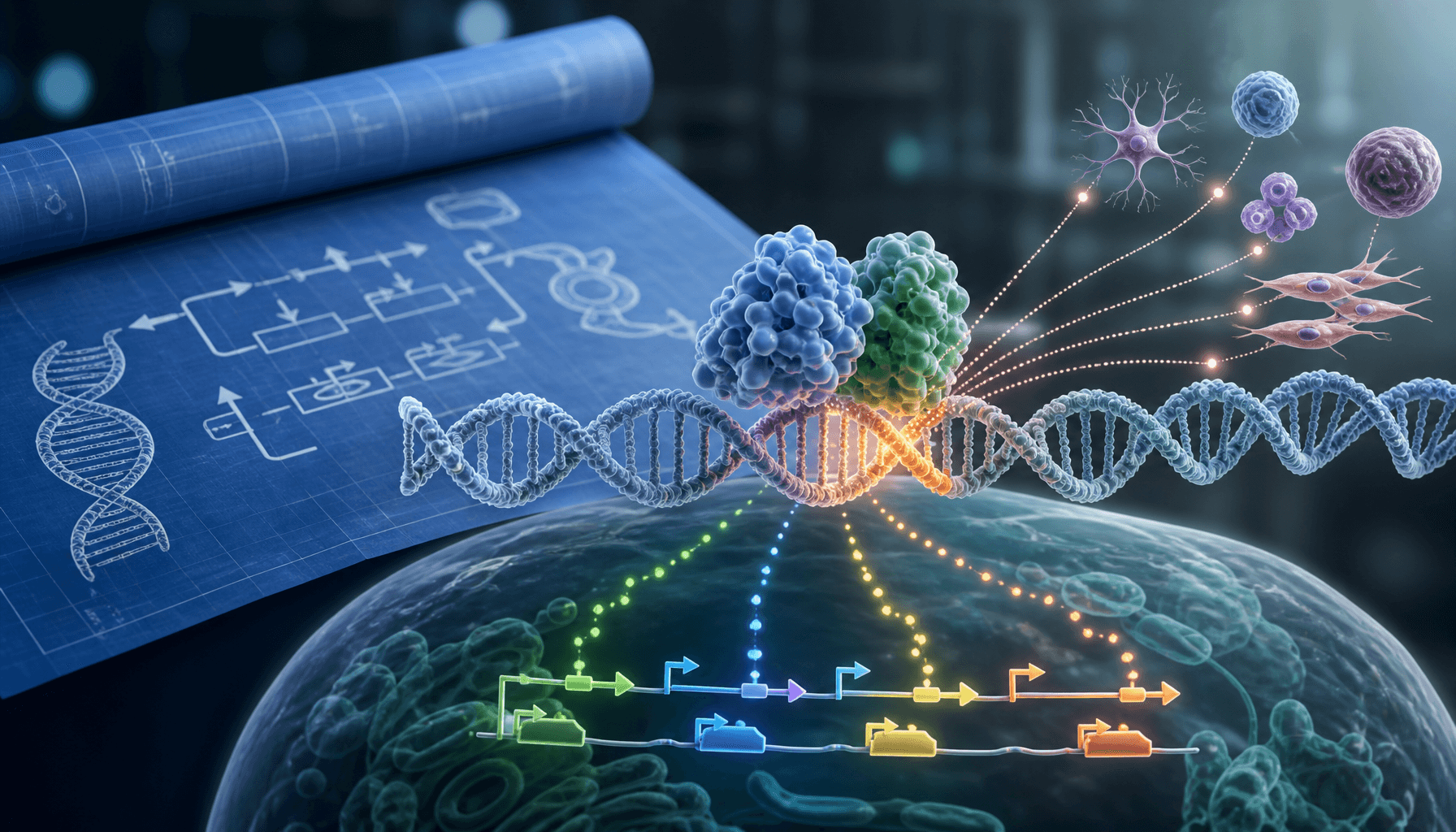
Biomedical research is undergoing a profound paradigm shift. Where we once relied on massive sequencing to capture static snapshots of biological states, today’s findings demonstrate that we are gaining the ability to intervene directly at the logic-gated control layers of cellular function. From hijacking bacterial sensory circuits to engineering metabolic clocks for cancer prognosis, we are entering an era of 'cellular logic reprogramming.'
Disrupting Sensory Perception to Combat Antimicrobial Resistance
In the face of the global antimicrobial resistance crisis, research by Liu et al. (published in bioRxiv) offers a departure from the traditional 'kill-or-be-killed' approach. By identifying that Yersinia pseudotuberculosis intercepts host signals through three distinct sensory receptors (YcrA, NarX, and CusR), the researchers demonstrated that we can 'disarm' pathogens rather than killing them. By repurposing suramin sodium to block the YcrA sensor, the team effectively blinded the pathogen, preventing it from orchestrating its virulence program. This strategy minimizes selective pressure, thereby bypassing the evolution of resistance, and suggests a future where anti-infectives are designed to neutralize sensory perception rather than viability.
Orchestrating Cognition: Thalamic Regulation and Metabolic Networks
In neuroscience, our understanding of how the brain manages complex social cognition—such as Theory of Mind (ToM)—has evolved significantly. Lu et al. utilized a dual-modality approach, combining 7T fMRI and sEEG, to identify the human thalamus as a regulatory hub. Intriguingly, the thalamus lacks local ToM-related activity; instead, it coordinates the Default Network (DN) via cross-frequency phase-amplitude coupling (PAC). This reveals that high-level social computation is gated by deep-brain structures acting as orchestrators rather than local processors.
Simultaneously, Deery et al. used functional FDG-PET to show that cognitive flexibility is supported by the brain's ability to switch between a sparsely connected baseline and highly integrated network states. This switching is enabled by a low-dimensional neurochemical hierarchy, with a specialized noradrenergic gate controlling departures from stable network architectures. These insights provide a metabolic foundation for understanding cognitive decline and psychiatric disorders.
Precision Oncology and the Metabolic Clock
Cancer research is similarly moving toward mechanistic decoding. Fabrini and Froehlich introduced 'Deep Mechanistic Models' (DMMs), which couple representation learning with ordinary differential equation models of signaling pathways. By applying this to breast cancer data, they identified that signaling heterogeneity is largely driven by pathway-extrinsic factors—such as baseline ERBB2 activation—rather than core mutations alone. Furthermore, Unfried et al. developed a 'lipid-based aging clock' that serves as a powerful prognostic tool. By analyzing serum lipidomics, they created a 'Lipid Age' metric that predicts survival and disease progression in pancreatic cancer patients with higher accuracy than standard clinical markers, highlighting the predictive power of systemic metabolism.
Conclusion: Toward Scalable, Audit-Capable Medicine
As research moves forward, we are seeing the integration of automated reasoning and high-fidelity hardware. The use of large language models (LLMs) by Steing et al. to standardize metagenomic diagnostics represents a major leap in bringing expert-level adjudication to clinical settings at scale. Coupled with microfluidic innovations like the T-Chip for clinical-scale T-cell purification, these technologies suggest that the future of medicine is modular, automated, and audit-capable.
In summary, the next generation of biotechnology is no longer just about identifying new drug targets; it is about building a toolkit to decode, simulate, and reconfigure the regulatory logic of biological systems. Whether we are hacking bacterial sensors or modulating thalamic gating, we are increasingly defining the rules by which life operates.