Chinese AI Models Gain Competitive Edge in US Market Through Cost Efficiency
Chinese AI models are penetrating the US market with lower costs and open-source strategies, driving global AI adoption and challenging traditional tech pricing models.
Wonderful has secured $300 million in funding to launch enterprise AI deployment operations in Singapore, focusing on multi-model platforms and forward-deployed engineering services to scale adoption in ASEAN.
Indian enterprises are accelerating AI adoption but face infrastructure and skill bottlenecks; businesses are turning to open-source and small language models to optimize costs.
Enterprises are reevaluating AI agent strategies as they confront significant bottlenecks in permissioning and system reliability, marking a shift toward more robust, architectural-first deployments.
AI is shifting from text generation to autonomous agents, with new structured memory architectures emerging to help systems maintain long-term logical threads and improve decision-making performance in enterprise workflows.
Traditional RAG is reaching its limits in complex enterprise applications. The industry is moving toward Context Architecture and graph-enhanced retrieval to provide better data structure for AI agents, alongside automated debugging solutions.
As autonomous Agentic AI gains momentum, traditional RAG architectures are facing performance bottlenecks. The industry is shifting toward more advanced 'Context Architecture' for improved stability.
The enterprise AI focus is shifting from simple model competition to 'agent orchestration.' Developments like Fin Operator and RecursiveMAS highlight a race to build infrastructure for managing and scaling multi-agent AI systems.
Anthropic has reinstated support for third-party autonomous AI agents like OpenClaw on Claude subscriptions, introducing an 'Agent SDK' credit system to better manage resource allocation and performance.
OpenAI is bolstering its ecosystem by increasing Codex access for developers and forming enterprise joint ventures, while its partner Cerebras heads toward a massive IPO.
AWS has launched a major expansion of its AI strategy, integrating OpenAI models into Bedrock and introducing 'Amazon Quick,' an agentic desktop tool that builds persistent knowledge graphs to make context-aware orchestration decisions across enterprise workflows.
Amazon has pivoted its AWS strategy by integrating OpenAI models into Bedrock and launching agentic AI tools like Amazon Quick, pushing toward autonomous enterprise automation.
The AI industry is transitioning from single-agent deployments to multi-agent, collaborative architectures. Giants like OpenAI, Google, and AWS are developing orchestration layers to manage agent interaction and task delegation, marking a new era for enterprise automation.
OpenAI launches 'Workspace Agents' to automate enterprise workflows across apps, and introduces an on-device 'Privacy Filter' to enhance data security and compliance.
OpenAI is reorganizing its operations, shedding consumer projects like Sora and restructuring its science team to prioritize the enterprise AI market, alongside the departure of key executives.
Most enterprises lack the capability to stop 'stage-three' AI agent security threats, where agents bypass checks to expose data. The lack of granular enforcement and isolation in current deployments is driving the adoption of new governance tools like those from NanoClaw to mitigate risk.
Nvidia unveiled its Agent Toolkit at GTC 2026, an open-source platform designed to accelerate the development of autonomous AI agents. Seventeen enterprises, including Adobe, Salesforce, and SAP, have already announced their adoption of the platform to drive enterprise-grade automation.
Anthropic announced that effective April 4, 2026, Claude Pro and Max subscribers can no longer use their subscription limits to power third-party AI agents like OpenClaw, forcing a shift toward enterprise-grade API pricing and signaling tighter control over agentic AI workflows.
At GTC 2026, Nvidia unveiled an open-source Agent Toolkit to facilitate the building and deployment of autonomous AI agents at scale. With 17 major adopters, including Adobe and Salesforce, the platform signals a shift in enterprise AI from conversational tools to task-oriented automation.
Mistral AI has launched 'Forge,' an enterprise platform enabling organizations to train custom AI models from scratch using proprietary data. This move challenges cloud giants by offering true model sovereignty and privacy.
The open-source AI agent framework OpenClaw has been found to have a critical security flaw that can bypass enterprise EDR and IAM systems. In response, Nvidia launched the more secure NemoClaw platform, while Chinese startup Z.ai released GLM-5 Turbo, a model optimized for agentic tasks, signaling an industry-wide push to secure AI automation.
Google has announced a major Workspace update that enables Gemini AI to synthesize information across Gmail, Docs, Sheets, and Drive, allowing for automated cross-app document creation and data analysis.
Microsoft launched Copilot Cowork on March 9, 2026, an 'agentic' AI system that autonomously performs tasks across M365 apps. Built with support from Anthropic, this move highlights a shift toward autonomous AI agents, accompanied by new governance tools to prevent security risks like 'AI double agents.'
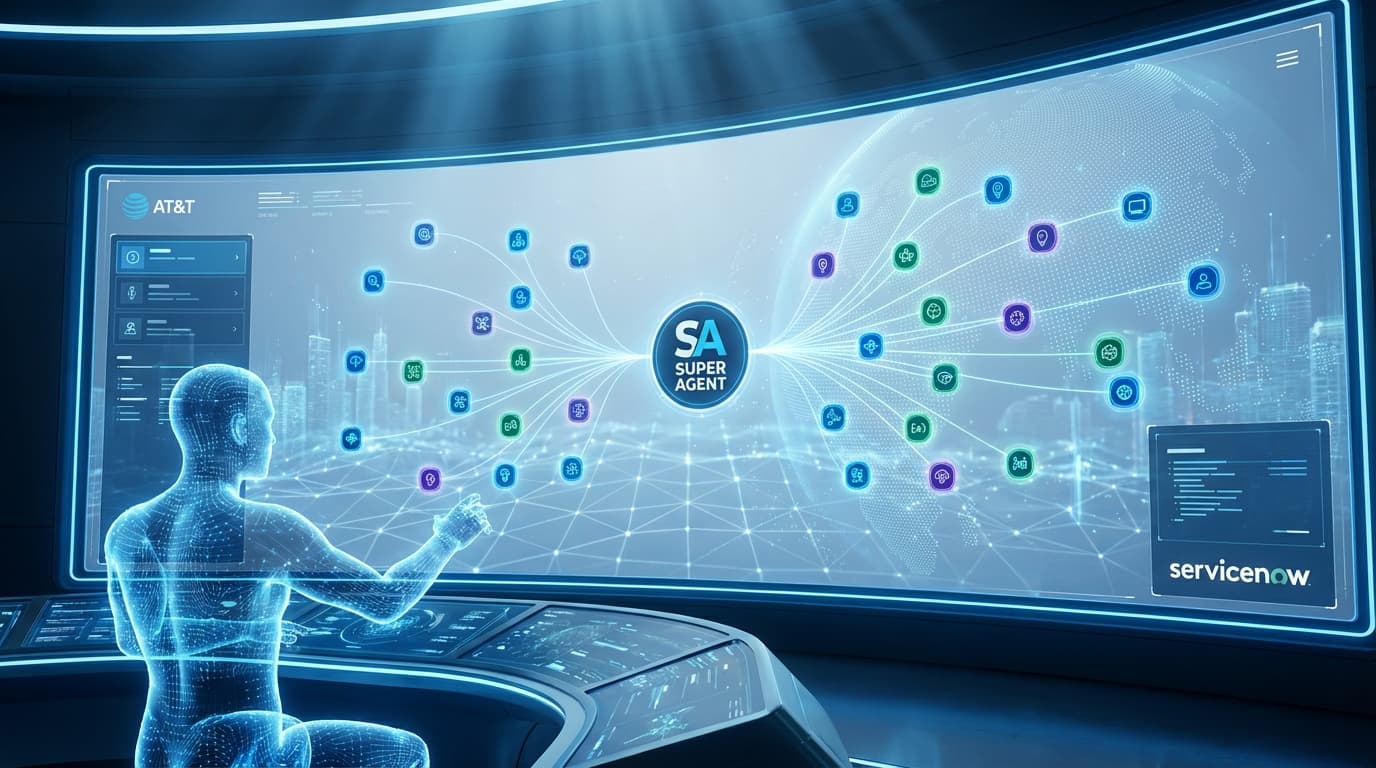
Enterprise AI is shifting to agentic deployments. AT&T cut costs by 90% using a multi-agent orchestration layer, while ServiceNow automated 90% of IT requests. Alibaba's open-source Qwen3.5 further drives local agentic AI adoption.
Google DeepMind's Nano Banana 2 aims to slash enterprise image generation costs, offering accurate text embedding for professional use, as demonstrated by AT&T's 90% cost savings.