Background: Carbon Emission Challenges in Construction
In the pursuit of global net-zero goals, the construction industry stands at a critical juncture. As one of the largest sources of carbon emissions, the improvement of cement production processes has become a core issue in sustainable engineering. According to recent agendas from organizations like RILEM, academia and industry are actively exploring innovative technologies for 'CO2 storage in concrete,' aiming to transform building materials into carbon sinks rather than carbon sources.
Technical Details: CO2 Mineralization and Digital Fabrication
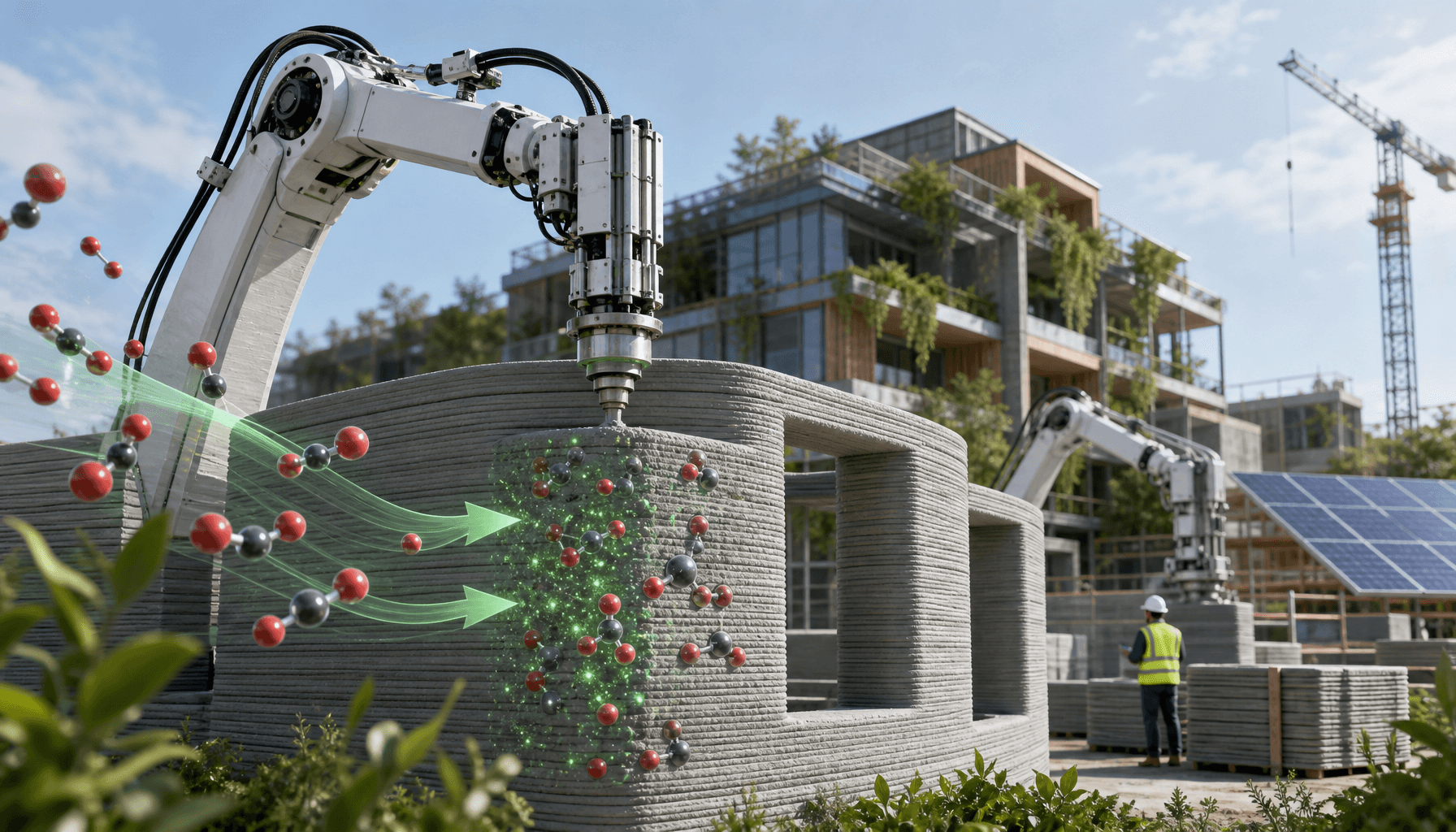
The latest research focus lies in how to sequester gaseous carbon dioxide into the chemical structure of concrete through mineralization technology. According to studies indexed in PubMed, this approach not only enhances the durability of concrete but also effectively reduces the net carbon footprint of the entire production process. Furthermore, the 5th RILEM International Conference on Concrete and Digital Fabrication explored how 3D-printed concrete can optimize material usage to further lower energy consumption. These technologies are transforming construction from a traditionally high-energy-consuming industry into an advanced manufacturing sector with intelligent decarbonization capabilities.
Market Trends and Data Support
Market interest in these technologies is rising. Google Trends data shows that search interest for 'low-carbon cement' reached 85 in California and 62 in Taiwan, reflecting an urgent global engineering demand for green building materials. Multiple peer-reviewed studies (e.g., in the journals Materials and J. Environ. Manage.) confirm that mixing CO2 into concrete is not only technically feasible but has already demonstrated favorable economic benefits in commercial applications.
Future Regulatory and Development Outlook
In the future, as nations tighten regulations on the carbon footprint of buildings, low-carbon concrete technology will become a key factor for market entry in construction. Legal experts suggest that governments should accelerate the deployment of these innovative materials through carbon taxes and green procurement standards. Looking ahead, the construction industry will evolve from the mere stacking of physical structures into an ecosystem integrated with Carbon Capture, Utilization, and Storage (CCUS) strategies.
Conclusion
From the agenda of the CO2STO2027 workshop, we can clearly see a trend: the construction industry is shifting from a defensive stance of emission reduction to an aggressive offensive of carbon sequestration. With the deep integration of digital fabrication and low-carbon materials, building a sustainable future city is no longer just a theory, but an ongoing engineering revolution.